

When Energy Beats Logic: Channeling Kirby Tech In Steamroller Man
Using scale, detail, and abstraction to slow the reader down. FROM THE ARCHIVES: Issue One, Page Twenty

This week’s post continues my From The Archives series, where I revisit one of my earlier pages and provide some insight on its creation. I’m going in chronological order, so that those of you who have just discovered the comic can get caught up!
Greetings from the storied Steamroller Man Archives!
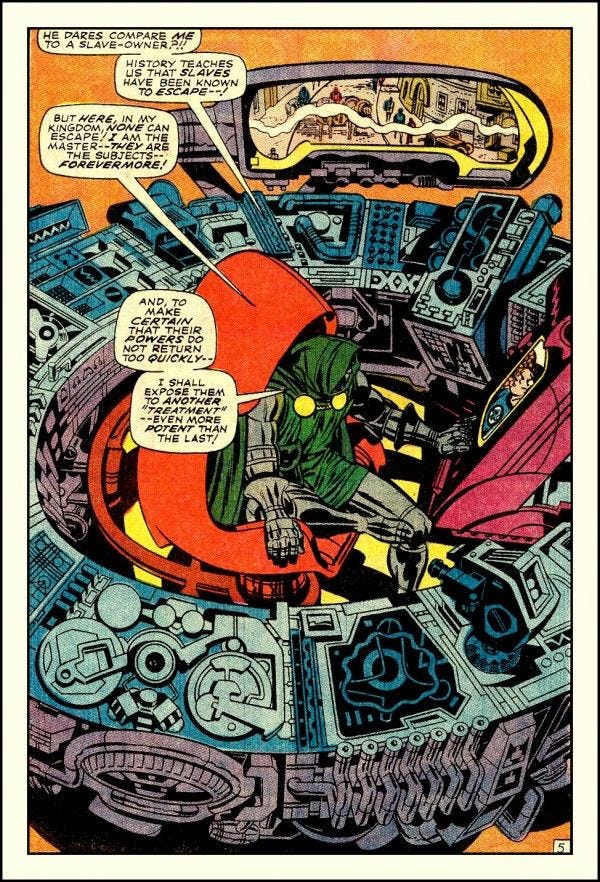
Today I bring you a look back at another page from issue #1. This page shows my Kirby influence right on its sleeve. I’ve always loved, and been intrigued by, the way American comics master Jack Kirby drew technology and machinery. He seemed to approach it in a purely expressionistic and somewhat nonsensical manner. The objects he drew only had to read, visually, as the idea of “machinery” or “technology” without any thought to the logic of how they could possibly exist or function in a real world setting. He was making his art back in the days when the primary audience for his comics were children, so realism always took a back seat to the feel, the energy, and the raw essence of the idea he was trying to communicate. It didn’t matter how it worked, it just had to look impressive and cool. Dazzling you with its complexity was the point. I kept all this in mind as I designed my page.
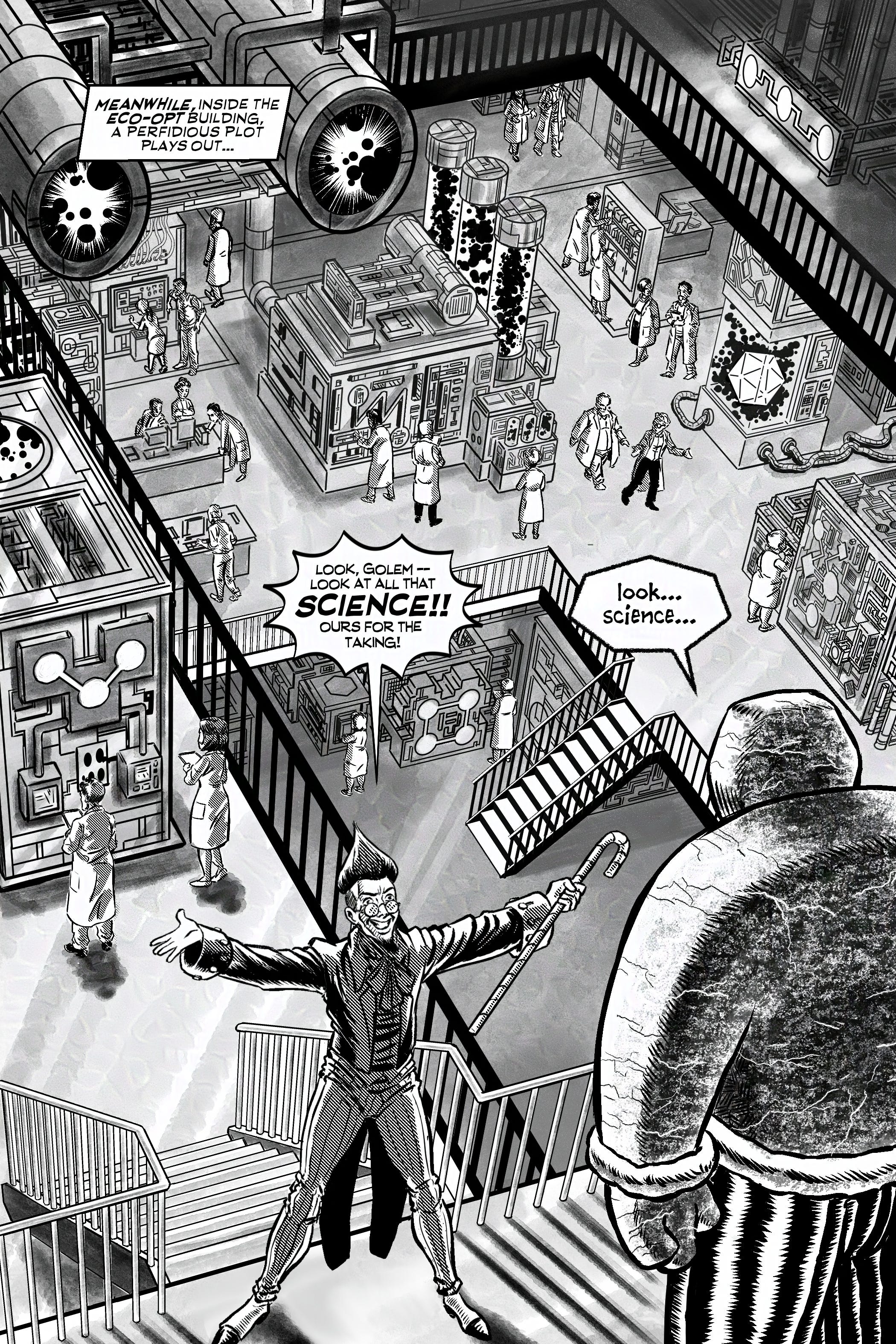
On my page, I wanted to convey the idea of “Science Lab” by filling the space with people in lab coats and abstract technology. I had already drawn the exterior of the building on page thirteen, and had made it quite a large building. At that point I wanted to convey the idea of the impressive size and scale of the lab, not realizing that the interior would have to be designed to match. In hindsight, the story point didn’t really depend on it being a large lab - Paige could have been working on her experiment in a smaller facility. I could have saved myself the bother of drawing a LOT of stairs with just a bit of careful thought and planning! Oops! I’m not really the type of artist who decides what to draw by planning how to put less work into a page. I’m drawing the comic for my own enjoyment and there is no deadline involved, so I just want to make it look cool.
With a full page panel AND a page-turn to reveal this left-side page, I’m using two of the strongest comic storytelling tools available to me, hopefully to make the reader pause with a Keanu-Reeves-like “whoa”. As I said in my previous From The Archives post, the time a reader spends looking at each panel depends on its size on the page, and the amount of detail in the art. So I wanted to maximize both here, just as Kirby did. I roughed out the machines and consoles in the composition by just drawing boxes and cylinders, and then improvised the details on the outside of those shapes as I inked. I could do this because, as I said, the details aren’t important, they only have to look important. Circles connected by zig-zaggy lines, and the ubiquitous black dots representing energy were a constant feature of Kirby’s technology, so I knew I had to homage those in this piece. I don’t remember where the idea to have a machine containing an icosahedron (also known as a twenty-sided die for you role-playing gamers out there) came from - again, I just thought it would be weird and cool. I believe I just found a photo of a d20 online and traced it directly, as Wally Wood famously advised.
I wanted the body language of the scientists to suggest attitude and demeanor, and convey that real interactions were happening. In certain spots, I reused penciled figure poses and just varied them in the inking.
There’s not a real strong gag on this page. I try to have at least one joke on as many pages as I can, but Sugar Daddy is not a real jokey character, so I went for a more subtle, ironic line about wanting to “take” the abstract concept of science.
This page, and the next few pages to come, made me NEVER WANT TO DRAW STAIRS AGAIN! In fact, after the experience of drawing so many stairs in this issue - which are tedious and difficult to draw correctly in perspective - I now notice and appreciate when any comic artist actually draws stairs well.. and stairwells… well. I also now have a keen sense for when an artist is using clever compositions to avoid having to draw them!
That’s it for this week! I hope you’ve enjoyed this look back at this early page! For paid subscribers, I share some of the interim stages of this page, behind the paywall. Thanks for reading, sharing and subscribing!
Keep Rolling!
Matt
