

How to Make Better Comedy With Contrast: Villains & Henchmen
FROM THE ARCHIVES: Issue One, Page Sixteen

This week’s post continues my From The Archives series, where I revisit one of my earlier pages and provide some insight on its creation. I’m going in chronological order, so that those of you who have just discovered the comic can get caught up!
Hello again!
I’ve just gotten back from overseas, and brought a cold back with me, so I’m VERY woozy and jetlagged. But I wanted to keep up with my regular email schedule, so here are some (hopefully coherent) thoughts on this page:
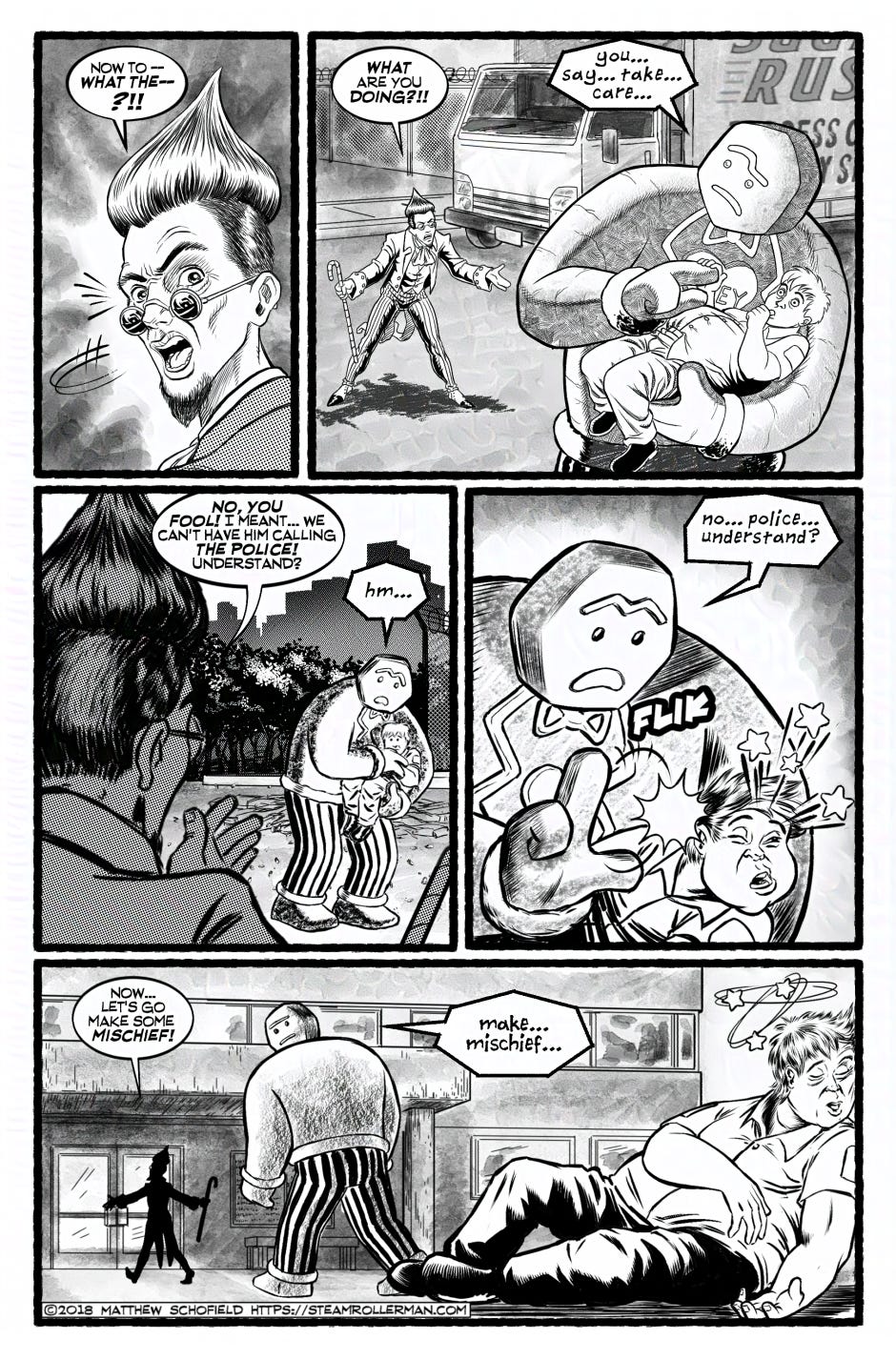
This page is memorable to me because it was where I first started to develop the comedic relationship between Sugar Daddy and The Gingerbread Golem.
Their dynamic is not startlingly original; they’re a study in contrast, which has been a staple of both comedy and drama perhaps since fiction began - pairing two characters with very different, and usually clashing, personalities. This trope works across genres, from romance, to “buddy cop” movies, to comedy. It’s become a trope because it works so well!
Contrast is interesting to us as human beings, and is a building block of characters with any degree of depth. In this case, it takes the form of the Evil Genius and his Dimwitted Henchman, a relationship which you’ve probably seen in many different forms across all types of media. A few examples that come to mind are Doctor Frankenstein (“FRONKen-shteen”) and Igor (“Eye-gor”) from Young Frankenstein (1974); Lex Luthor and Otis from Superman: the Movie (1978); in animation, Yzma and Kronk in Disney’s The Emperor’s New Groove; and the title characters in Warner Bros’ Pinky and The Brain. It runs along the lines of the comedy trope identified by the website TV Tropes as the Smart Jerk and Nice Moron.
I felt it was important to the story that, despite the comedy, the villain would come across as authentically misanthropic, if not irredeemably evil. The hero, Steamroller Man, comes off as a joke, but I think that’s okay. If the hero is a buffoon, it makes you wonder how they could possibly win. But if the villain of a story also comes across that way, then I think it lowers the stakes of the story and deflates any sense of suspense. A reader won’t believe there’s any danger of the villain winning if he’s played as a joke. Give him a henchman that is constantly a thorn in his side, though, and you can retain his menace while also injecting some comedy into their scenes. Having him frustrated, and acting so horribly towards a simple-minded subordinate, punching down as it were, can serve to strengthen his villainous personality and hopefully make the audience loathe and perhaps fear him even more.
As I write this, I’m realizing that this Contrasting Pair dynamic is one I’ve used a few times over the course of the story, and if you’ve read further ahead than this page, you’ll know what I mean. It’s a great literary device, as it immediately generates conflict, which is essential to both drama and comedy. If you haven’t read further in the story, and would like to, just click the banner below!
One last thing to say about this page: in the final panel, I have the unconscious security guard leaning up against the panel border. This is an intentional fourth-wall break, which I did to subtly reinforce to the reader that they were reading a fictional comic book. There’s no physical object in his environment for him to lean on - the panel border technically does not exist in his world… or does it, in some strange way?
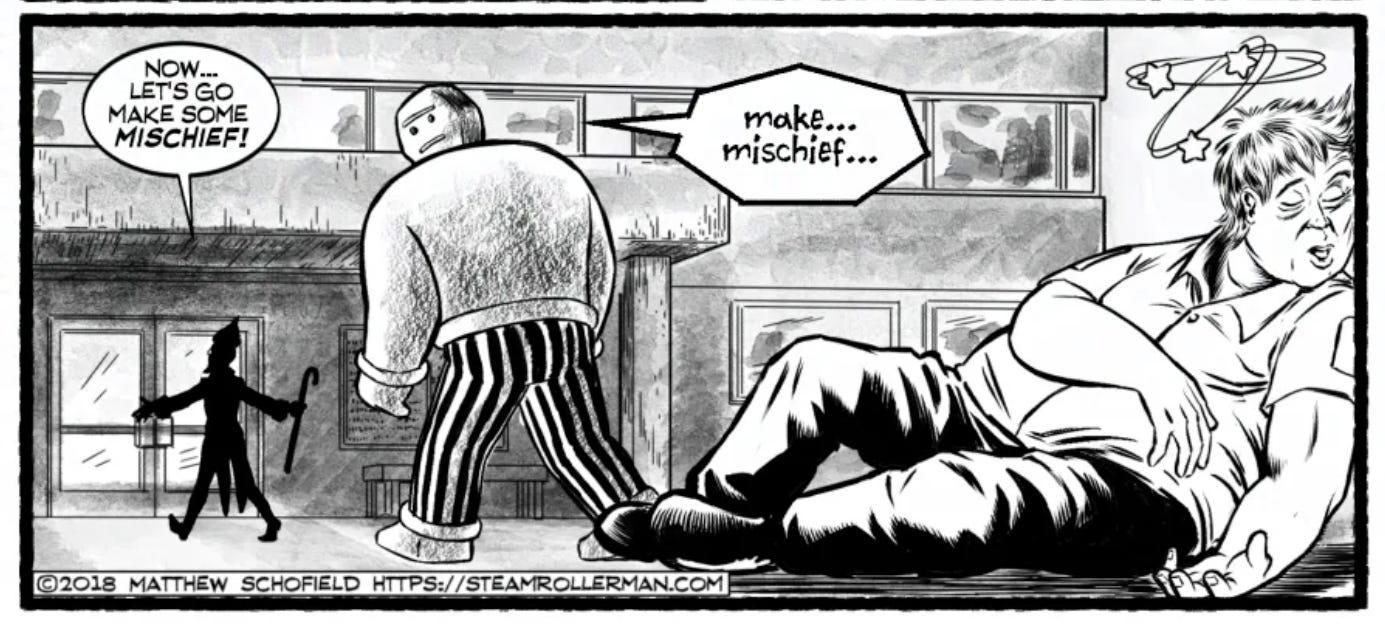
I made this little visual mind-bending gag because at this early stage of making the comic I was being asked questions online that wanted logical, real-world answers as to how a man with a giant Steamroller head could possibly exist and operate in our world. This frustrated me to no end and I often wanted to reply “HE’S… NOT… REAL!!! This is a COMIC!!” Instead, I started to do subtle things like this. Some people get it, some don’t.
If you’re a paid subscriber, below you’ll see the original version of this page, along with some early process stages of its creation, along with more of my incessant yammering.
Thanks for reading, and Keep Rolling!
Matt
Keep reading with a 7-day free trial
Subscribe to Steamroller Man to keep reading this post and get 7 days of free access to the full post archives.